

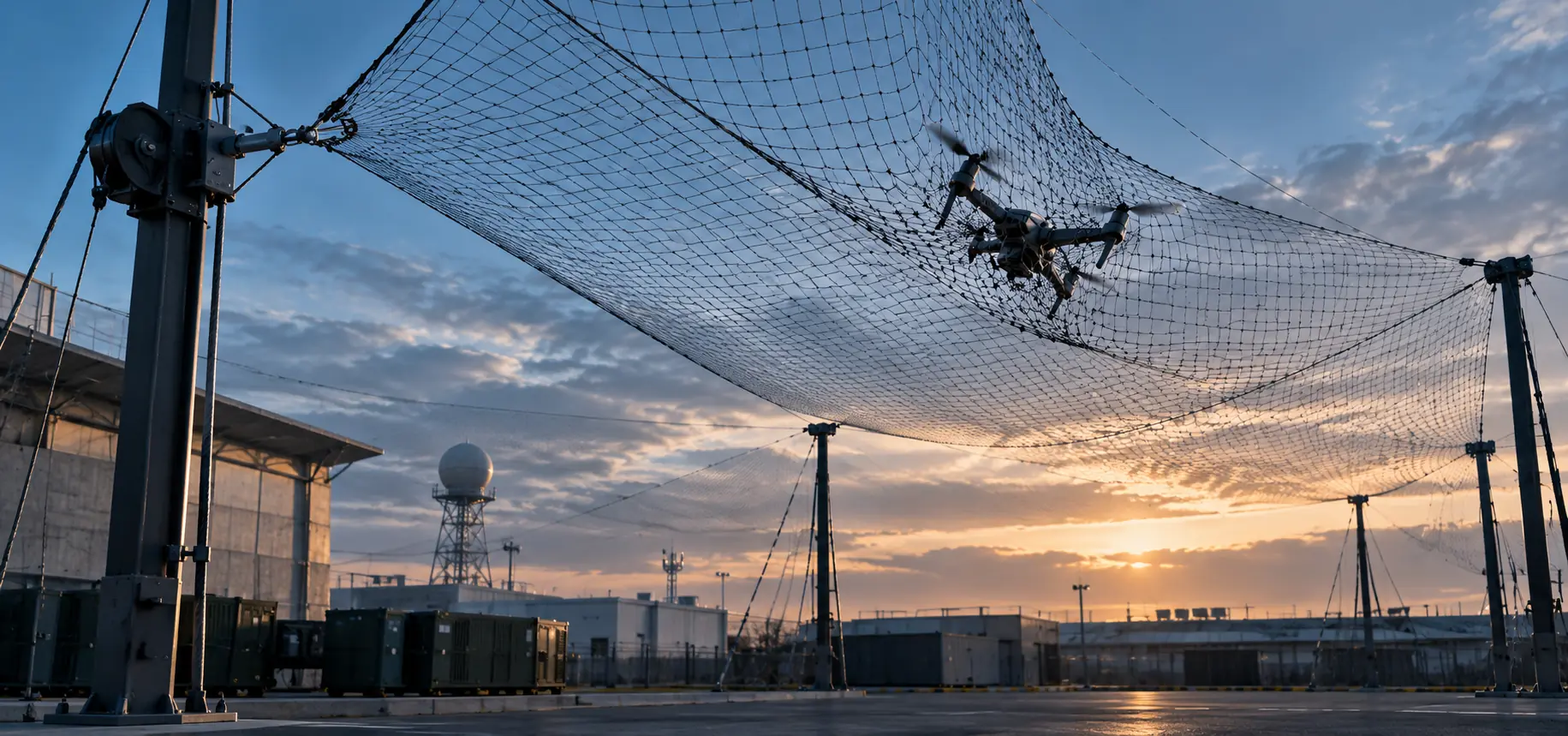
Drones have made rooftops, plant rooms and building facades accessible in a way that fences and walls never anticipated. For critical buildings such as control rooms, data centres, substations and government facilities, a passive physical net is one of the simplest and most reliable ways to reduce the risk of a direct drone impact. This guide explains how to plan one.
1. Start with the drone, not the net
The right net depends on what it has to stop. Before choosing any product, define the threat: the type of drone, its weight, its likely speed and the direction it can come from. A small FPV drone and a heavier multirotor or fixed-wing UAV call for very different systems.
Kinetic energy rises with the square of speed, so speed matters more than weight. As a rough example, a 1 kg drone at 30 m/s carries about 0.45 kJ, while a 25 kg fixed-wing UAV at 40 m/s carries about 20 kJ. Our selection guide walks through this step in more detail.
2. Decide what needs protecting
Not every square metre of a building needs a net. Focus on the parts that matter most:
- Rooftop plant: chillers, transformers, generators and communication equipment
- Skylights, glazed roofs and lightweight roof areas
- Building entrances, courtyards and parking structures
- Facades with vulnerable openings or equipment
3. Choose the layout
Roof-level canopy
A horizontal net held above the roof on columns and cables. The net sits at a stand-off height above the equipment, so a drone is stopped before it reaches the roof.
Vertical screens
Nets hung in front of facades or around plant enclosures to stop drones approaching from the side. They are often combined with a canopy.
Full enclosure
Canopy plus screens on all sides for the most critical equipment, such as a transformer yard or a rooftop communication mast.
4. Leave room for the net to work
A net stops a drone by deflecting and absorbing energy, so it needs clear space behind it. The stand-off distance between the net and the protected equipment is part of every design. Higher threat energy means more deflection and therefore more stand-off, or a stiffer support structure.
5. Pick the right material
Synthetic knotless and knotted nets are light, economical and quick to install, and they suit small drones and large areas. Steel rope nets are non-combustible and more durable, which makes them a good fit for permanent installations, hot areas and coastal sites. For heavier UAV threats, a double-layer steel system such as the AD-500 System is used. Read our comparison of knotless, knotted and steel nets.
6. Check the structure and sensors
The net transfers loads into its columns, cables and anchors, and the roof structure may not be able to carry them. Your structural engineer should confirm wind, snow and impact loads before installation. Keep nets clear of antennas, radar and sensors, or use synthetic net windows in their field of view.
7. Plan for maintenance
Inspect cable tension, fixings and panels regularly and after storms. Choose a modular system so a damaged panel can be cut out and replaced on site.
Next step
If you are planning drone protection for a building, send us the roof plan or a few photos and the threat you need to stop. We will propose a layout and a budgetary quotation. Contact MAISHI.
Leave a Reply