
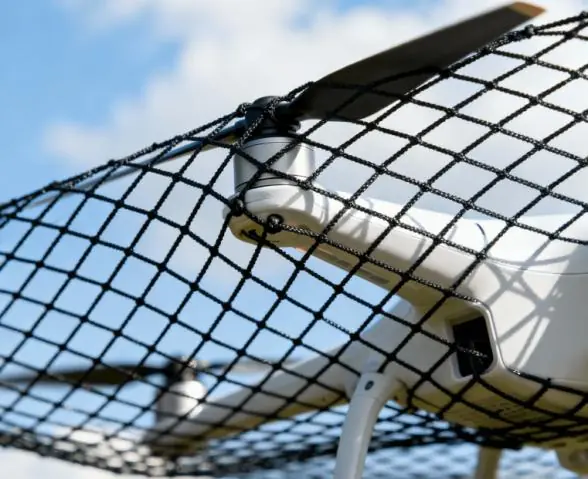
Anti-drone nets come in three main families: knotless synthetic nets, knotted synthetic nets and steel rope nets. Each has clear strengths. This comparison helps you match the net to your threat, your site and your budget.
Quick comparison
| Knotless synthetic | Knotted synthetic | Steel rope net | |
|---|---|---|---|
| Weight | Lightest | Light | Heaviest |
| Mesh stability | Good, mesh stays square | Very good, knots lock the mesh | Very good |
| Handling | Easy, smooth surface | Easy, robust | Needs more effort and hardware |
| Fire behaviour | Combustible; flame-retardant grades available | Combustible; flame-retardant grades available | Non-combustible |
| UV and heat | UV-stabilized grades | UV-stabilized grades | Unaffected by UV |
| Typical service life | Medium, depends on UV exposure | Medium, depends on UV exposure | Long |
| Relative cost | Lowest | Low | Higher |
| Best for | Large canopies, venues, temporary protection | Tank side nets, perimeters, frequently handled nets | Permanent sites, ports, vessels, hot or fire-exposed areas |
Knotless nets
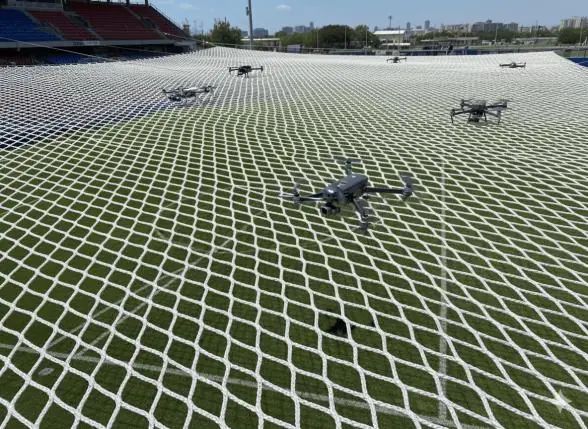
In a knotless net the twines are interlaced at each crossing instead of tied. The result is a smooth, uniform and light net with low wind drag. Knotless nets are the most economical way to cover large overhead areas and are easy to roll out on cable grids or truss. They suit small drones and FPV craft. See MAISHI knotless nets.
Knotted nets
Knotted nets are tied at every crossing, which gives high node strength and a mesh that does not slip under load. They are a good choice for storage tank side nets, stand-off barriers and nets that are handled, moved or re-tensioned often. See MAISHI knotted nets.
Steel rope nets
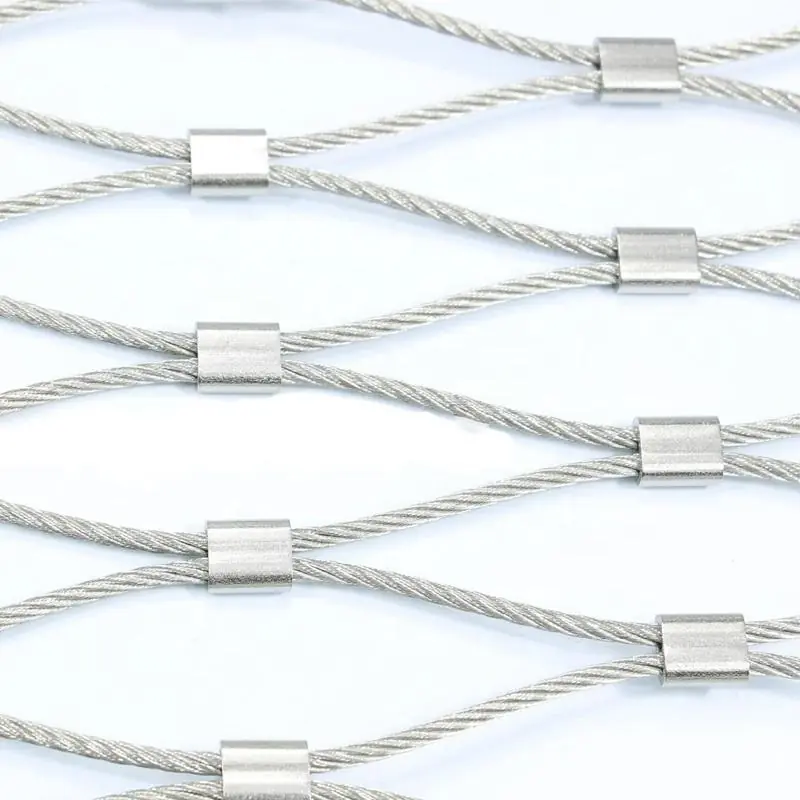
Steel rope nets are made from stainless or galvanized wire rope. They are non-combustible, resist cutting and abrasion, and last much longer outdoors than synthetic nets, which makes them the preferred option for permanent installations, coastal sites, vessels and areas with fire or heat exposure. See MAISHI steel rope nets.
When you need more than a single net
For larger, heavier and faster UAV threats, a single net layer is not enough. The MAISHI AD-500 System combines two steel net layers with energy-dissipation rings on an engineered cable structure, and is designed per project against your threat definition.
How to decide
- Small drones, large area, budget-sensitive: knotless synthetic net
- Tank side nets, perimeters, frequent handling: knotted synthetic net
- Permanent, coastal, hot or fire-exposed sites: steel rope net
- Heavier UAV threats at critical assets: AD-500 System
Many projects combine nets, for example knotted side nets with a knotless top net on a storage tank, or steel rope nets near hot equipment and synthetic nets elsewhere. Not sure which fits your site? Ask our team for a recommendation.
Leave a Reply